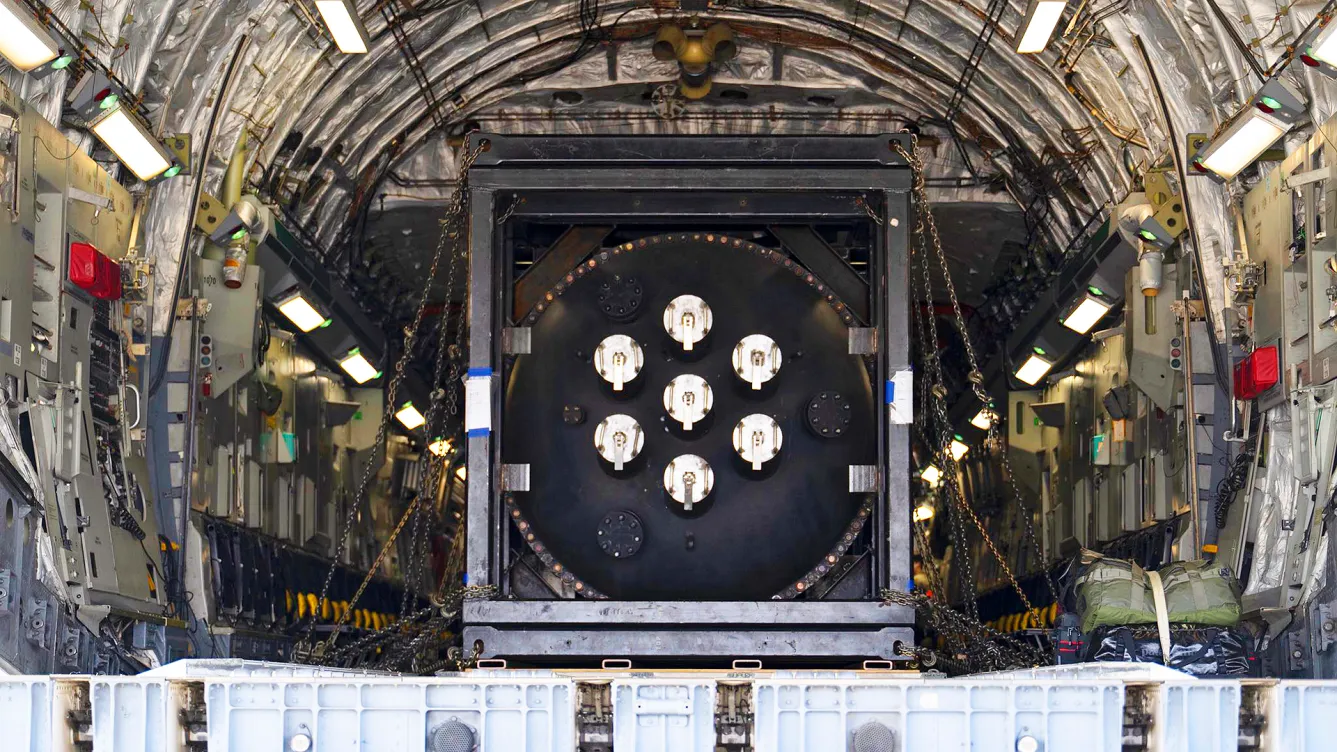
美国能源部和国防部周日首次使用货机将一座小型核反应堆从加利福尼亚州运往犹他州,以展示快速部署核能用于军事和民用领域的潜力。
这两个部门与总部位于加利福尼亚州的瓦拉原子能公司合作,用C-17运输机将该公司的一座沃德微型反应堆(不含核燃料)运往犹他州希尔空军基地。
能源部长克里斯·赖特和负责采购和保障的国防部副部长迈克尔·达菲乘坐C-17运输机携带反应堆及其组件,并称赞此次行动是美国核能和军事后勤领域的一项突破。
达菲表示:“这使我们更接近于在需要的时间和地点部署核能,为我们国家的作战人员提供赢得战争的工具。”
唐纳德·特朗普总统的政府将小型核反应堆视为扩大美国能源生产的几种途径之一。
去年五月,特朗普签署了四项行政命令,旨在促进国内核能部署,以满足国家安全和人工智能发展对能源日益增长的需求。
去年12月,美国能源部发布了两项拨款,以帮助加快小型模块化反应堆的开发。
微型反应堆的支持者一直称赞它们是可输送到偏远地区的能源,可以替代需要频繁燃料运输的柴油发电机。
但怀疑论者认为,业界尚未证明小型核反应堆能够以合理的价格发电。
忧思科学家联盟核电安全主任埃德温·莱曼表示,“微型反应堆没有商业价值,即使它们能够按设计运行,其发电成本也远高于大型核反应堆,更不用说风能或太阳能等可再生能源了。”
赖特表示,能源部计划在7月4日前使三个微型反应堆达到“临界”状态——即核反应能够自我维持的状态。
据瓦拉原子能公司首席执行官以赛亚·泰勒介绍,周日活动中的微型反应堆比小型货车略大,发电量可达5兆瓦,足以满足5000户家庭的用电需求。他表示,该反应堆将于7月开始运行,初始发电量为100千瓦,今年将达到250千瓦的峰值,之后逐步提升至满负荷运转。
瓦拉原子能公司希望在2027年开始试售电力,并在2028年实现全面商业化运营。泰勒表示,尽管私营企业自行研发核技术,但也需要联邦政府“采取一些扶持措施,允许在这里进行燃料制造和铀浓缩”。
赖特告诉记者,瓦拉反应堆的燃料将从内华达州国家安全基地运往圣拉斐尔的设施。
然而,莱曼指出,即使是小型发电机也会产生大量的放射性废物。
其他专家表示,除了制定废物管理方案外,设计人员在设计之初并没有义务考虑废物问题。
赖特表示,尽管核废料处置仍是一个悬而未决的问题,但能源部正在与包括犹他州在内的几个州进行磋商,商讨建设核燃料后处理或永久处置核废料的场地。
The U.S. Departments of Energy and Defense on Sunday for the first time transported a small nuclear reactor on a cargo plane from California to Utah to demonstrate the potential to quickly deploy nuclear power for military and civilian use.
The agencies partnered with California-based Valar Atomics to fly one of the company’s Ward microreactors on a C-17 aircraft — without nuclear fuel — to Hill Air Force Base in Utah.
Energy Secretary Chris Wright and Under Secretary of Defense for Acquisition and Sustainment Michael Duffey were on the C-17 flight with the reactor and its components, and hailed the event as a breakthrough for U.S. nuclear energy and military logistics.
“This gets us closer to deploy nuclear power when and where it is needed to give our nation’s warfighters the tools to win in battle,” Duffey said.
President Donald Trump’s administration sees small nuclear reactors as one of several ways to expand U.S. energy production.
Trump last May issued four executive orders aimed at boosting domestic nuclear deployment to meet growing demand for energy for national security and competitive AI advancements.
The Energy Department in December issued two grants to help accelerate development of small modular reactors.
Proponents of microreactors also have touted them as energy sources that can be sent to far-flung and remote places, offering an alternative to diesel generators which require frequent deliveries of fuel.
But skeptics have argued that the industry has not proven that small nuclear reactors can generate power for a reasonable price.
“There is no business case for microreactors, which — even if they work as designed — will produce electricity at a far higher cost than large nuclear reactors, not to mention renewables like wind or solar,” said Edwin Lyman, director of nuclear power safety at the Union of Concerned Scientists.
The Energy Department plans to have three microreactors reach “criticality” — when a nuclear reaction can sustain itself — by July 4, Wright said.
The microreactor in Sunday’s event, a little larger than a minivan, can generate up to 5 megawatts of electricity, enough to power 5,000 homes, according to Valar CEO Isaiah Taylor. It will start operating in July at 100 kilowatts and peak at 250 kilowatts this year before ramping up to full capacity, he said.
Valar hopes to start selling power on a test basis in 2027 and become fully commercial in 2028. Although private industry funds its own development of nuclear technology, it also needs the federal government “doing some enabling actions to allow fuel fabrication here and uranium enrichment here,” he said.
Fuel for Valar’s reactor will be transported from the Nevada National Security site to the San Rafael facility, Wright told reporters.
However, even small generators result in a significant amount of radioactive waste, Lyman said.
Other experts have said designers are not compelled to consider waste at inception, beyond a plan for how it will be managed.
Although disposal of nuclear waste remains an unresolved issue, the Energy Department is in talks with a few states, including Utah, to host sites that could reprocess fuel or handle permanent disposal, Wright said.